Wednesday, May 2, 2012

The Co-op Mission Statement is not Co-op Policy

Yes, you read that right. After some 6 months of my pursuing an exchange with the Weaver Street Market Co-operative corporate office management team and the WSM Board of Directors, the BoD have confirmed to me in writing their support for the line of our General Manager that our Mission Statement is not co-op policy, and it matters not a fig if management are in compliance with it, or not.

Ok. Where did all this come from? Well, back in December 2011, I began a Dispute under WSM’s Employee Policy, claiming that management was in breach of co-op policy, because my work experience was not fulfilling (as the Mission Statement demands that it should be), since I was being asked to work harder and harder, without explanation, or the opportunity to discuss the situation with my fellow workers, and to be involved in the decision-making process that was asking me to work harder and harder (which Employee Policy and Board Policy both require).

Look. I know that’s a mouthful. But the path to co-operative and humanly-decent nirvana in our workplace sometimes needs a little injection of verbal diarrhea.

You can read the full exchange with the higher-ups in WSM in this booklet that I have prepared. Or, you can read on for the shorter version. And let me just say that there could be no better day for my writing this exposition, seeing as it is May 1, International Workers’ Day, and the WSM bigwigs are today providing hospitality (at who knows whose expense) to the even bigger-wigs from the visiting Board of the National Co-operative Grocers’ Association (of which our General Manager is a Board Member), at the swanky Aloft Hotel, here in Chapel Hill.

So. I submit my Dispute. WSM’s Human Resources Manager has first bite. She comes back and says that my work experience is what the WSM corporate office deem to be normal for someone at my work level (remember the LSWSW … ??). I replied to her that’s not what the Mission Statement demands. It doesn’t say my work experience should be what the corporate office finds ok. It should be fulfilling for me.

Next step up, the General Manager. He’s the one who said, well, the Mission Statement isn’t co-op policy. When I managed to pick myself up off the floor, and wipe away the tears of mirth, I wrote back to him and said, don’t be such a clot, of course it is. The Mission Statement is our very most basic co-op policy.

Next step up. Appeal to the WSM Board of Directors. They fiffed and they faffed for some four months. I eventually wrote to them and said, when on earth are you going to let me appear before you to address my appeal, as is the norm? They wrote back to me yesterday and said, we’ve made our decision without reference to you. Your Dispute is rejected. No explanation. No reasons. Goodnight. Goodbye. See ya.

I don’t care so much for me. I can look after myself in my workplace. But I care for all those of my fellow workers who don’t want to make waves, because they love the co-op, they just want to fit in, they want that pay raise, and they don’t want to risk losing promotion. There is nothing wrong with anyone feeling like that. It’s called self-preservation, self-respect and personal integrity.

What is wrong is when a co-op behaves like the very worst sort of 1% corporation, and takes advantage of the fears of its workers to impose upon them conditions which are close to exploitation. When that same co-op ignores all of its policy, and refuses to allow its workers (whom the GM keeps reminding us half-own the co-op) any meaningful opportunity to design their work experience, or to have some sort of control over their destiny.

We, at Weaver Street Market Co-operative, are supposed to be a part of the answer to the grasping, remote, uncaring, corporate capitalism that caused The Great Recession. Instead, we have become a part of that same corporate capitalism.

The most stinging act of all is the Board simply refused to address the two remedies I suggested to begin the process of ensuring our co-op and its corporate office management team were once more in compliance with co-op policy.

By way of remedy, I didn’t ask for a new car, or more money for me, or a nicer locker. No. I asked only that WSM hold a Full Meeting of all the Employees, where we would be able to quiz the corporate office management team, in the solidarity of numbers, as to why we need to go on working harder and harder, when we are already making a profit.

The second remedy was for the Board to set up a Task Force of worker- and consumer-owners to investigate the full financial situation of our co-op, determine if the financial goals were necessary, and to see if those goals impacted too deleteriously upon the workforce (not least by trying to find a way to allow workers to express their views in complete confidence).

By rejecting my Dispute, the WSM Board of Directors did not so much let me down; they let down all 220 of the employees of Weaver Street Market and Panzanella. That’s just plain sad. But. I’m not done. There are further avenues of redress. I will keep you updated.

In the meantime, whether you are a worker, a consumer or an owner with WSM, there is much that you can do. Go to the WSM web-site. Read the co-op ownership section. Attend meetings. Ask questions. Your co-op gets away with being less than the co-op it could be only because you do not pay more attention …

Friday, April 13, 2012

Taking Back Our Co-op [II]


This is the second of my two Notes on how we can return our very favorite local food co-op (Weaver Street Market) to being the very best co-op it can be - in addition to its being an efficient grocery store, specializing in local and organic food.

These two Notes arose as responses to questions raised in another discussion, wondering why WSM, as supposed bastion of the local alternative sustainable economy, has played and still plays no active institutional role in the Occupy dialogue.

So. Here is the body of this second Note:

"I moved heaven and earth to join Weaver Street in 2005. Done a lot in my life. My politics have changed dramatically. I wanted to support my creativity and advocacy by working somewhere that was supportive; which was not about trying to force folks to buy things they didn't want to buy; and which allowed regular conversation to ensure we all maintained the above.

The first thing I noticed, after a few months, was that folks were beginning to poke me in the back. Work harder. Sell more. Er. Why? We're making a profit.

And so, I asked where the conversation was. I've been asking ever since. I started the blog to keep a record. But that is all my advocacy within WSM has ever been about. Trying to create space for meaningful conversation.

The need for conversation became urgent (and has remained so ever since) in 2008, when a small group within WSM, without proper permission, undertook the now disastrous expansion of WSM, and borrowed $10 million to do so, without asking the ownership if this was ok.

How could they do this? Well, it comes back to my point about who actually owns WSM. You don't have to ask no-one if you have the assets in your back pocket ...

In any event, 'their' way of paying back the $10 million turned out to be asking workers to work harder and harder, without the necessary tools or compensation (because the failure of expansion has meant we can't afford those).

The need for conversation is to examine the finances, to see if there are better ways out of the financial muddle; to determine if WSM is in compliance with the Mission Statement that says that workers should have a fulfilling work experience, and consumers a fulfilling shopping experience; and to create new opportunities for ongoing conversation.

It really is no more complicated than that. It only becomes complicated because the WSM corporate office management team and their Board of Directors will do all in their power to avoid conversation.

How do we achieve the latter? To return us to being a co-op? Well, it's a constantly moving feast, 'cos the 'powers' constantly move the goalposts. But, here's my recipe for today:

1) Hold a full meeting of all employees in the co-op (we used to have one every year, until 2008), to allow employees to express their true feelings, in the solidarity of numbers. This is a part of the process I am undertaking at the moment. I'll let you know how it goes.

2) Request of the Board of Directors that they set up a Task Force of consumer and worker-owners immediately to investigate the finances of WSM (and the ownership of assets), to determine if they are sustainable (especially the program for repaying the debt), and in compliance with the norms of co-operative structure.

Also to investigate whether WSM is in compliance with the MS terms about fulfilling work and shopping experience. And to make recommendations. Again, I am pursuing this. But there is no reason why others could not turn up to a Board Meeting and demand the same.

3) Request a second Task Force of owners to review the structures of WSM to ensure they are truly co-operative, democratic and supportive of regular conversation.

We need to undo the situation which now allows the Board to change its own By-Laws without reference to the ownership.

We need to ensure that all Directors are elected. Currently, three of the seven are appointed - essentially by Ruffin Slater.

Ruffin should be the General Manager only. According to the governance model to which we subscribe, the GM should not be on the Board of Directors. Conflict of interest.

Worker-ownership should be made affordable to ordinary workers, so that the two worker-owner Directors are truly representative of ordinary workers.

I would like to see Discussion Groups established for consumer-owners and worker-owners, which have input to Board deliberations.

I would like to see an Online Forum for consumers, owners and workers, to which management and the Board would have to respond.

I would like to see all assets firmly under the control of the full ownership of WSM.

And that, I think, is a good start for getting WSM back to being an authentic community co-op.

Of course, none of this happens unless more than a few of us do the asking, the writing and the organizing ... "

Thursday, April 12, 2012

Taking Back Our Co-op [I]


I had some thoughts the other day about whether our very favorite local food co-op, Weaver Street Market, was actually owned by the community, and whether this might not be the reason for there being so little democratic conversation within the co-op.

One or two of you asked what we could do to take back our co-op. I had some further thoughts. I shared them as comments on Facebook. But I thought I would also post them here also, as separate Notes.

Aside from the dry detail, the answer is this: take notice, ask questions, go to meetings, get involved. Now, for the first of my dry comments:

"Well, I'm in the middle of something else. But I'll whet your appetite by saying that incorporation of co-operatives in North Carolina is covered by NC General Statute 54.

GS 54-157 has an interesting provision, which the Board of Directors of WSM might want to read:

"§ 54‑157. Breach of marketing contract of cooperative association; spreading false reports about the finances or management thereof; misdemeanor.

Any person or persons, or any corporation whose officers or employees knowingly induces or attempts to induce any member or stockholder of an association organized hereunder to breach his marketing contract with the association, or who maliciously and knowingly spreads false reports about the finances or management thereof shall be guilty of a Class 2 misdemeanor and subject only to a fine of not less than one hundred dollars ($100.00), and not more than one thousand dollars ($1,000), for such offense and shall be liable to the association aggrieved in a civil suit in the penal sum of five hundred dollars ($500.00) for each such offense: Provided, that this section shall not apply to a bona fide creditor of any member or stockholder of such association, or the agents or attorney of any such bona fide creditor, endeavoring to make collection of the indebtedness, or to any communication, written or oral, between a business company or concern and persons with whom it has an existing contractual relationship which communication relates to the performance of that contractual relationship and duties and responsibilities arising therefrom. (1921, c. 87, s. 25; C.S., s. 5259(dd); 1963, c. 1168, s. 14; 1993, c. 539, s. 430; 1994, Ex. Sess., c. 24, s. 14(c).)"

Bottom line? Being a co-operative these days isn't some happy-clappy vision, dreamt up on the Weaver Street Lawn. There are rules. There are protections.

Until now, I have been trying (these past seven years) to engage the 'powerbrokers' in WSM to return WSM to the democratic, community co-op it is supposed to be. With the help of a lot of other folks, I might add. It isn't just me.

I have one last attempt underway. Which I am necessarily not sharing at the moment. But there are sanctions if that last attempt at conversation fails. Sanctions which will not hurt the welfare of ordinary consumers, owners and workers. But which will catch the attention of those who are making decisions at the moment, without reference to those consumers, owners and workers.

More to follow. But, in the meantime, the most important things you can do are: (1) Go on buying - we who want things to change will achieve nothing if we hurt what it is we want to change; (2) Go to Board Meetings and at least observe; (3) Stand for the Board, and don't let yourself be bamboozled."

Wednesday, April 4, 2012

Why Is Weaver Street Not Engaged In The 'Occupy' Dialogue'?

When Occupy began last October, it represented for me a protest against the domination of our society and our economy by the uber-rich, their heartless banks and their gutless politicians.

I became involved when Occupy started up locally, and the conversation was about highlighting the deleterious effects of arbitrary authority and conventional corporatism in our local community.

In January of this year, Occupy Chapel Hill/Carrboro decided it was time to move from mere protest to discussion about alternative local possibilities, and engagement with the community to explore more community-orientation and democracy in our economy and political life locally.

One of the issues that has bothered me (note, I’m off the Carrboro Commune kick today!) is that at no point in this developing conversation has Weaver Street Market Co-operative been involved.

Here is an organization that declares to the world that it is a community-owned grocery store. The living, breathing exemplar of alternative, democratic economy and sustainable society in action – and we hear nothing from them in this new adventure in social economy we call ‘Occupy.’

Indeed, the only institutional contribution of WSM to the communal debate has been to keep very quiet and stay very still as the rest of us in Carrboro, NC try to work out where was the democratic discussion that preceded the sale by WSM of the plot of land soon to become the monstrosity known as CVS, to which everyone and his community-gardening uncle seems to be opposed.

The general understanding was that this property was going to be redeveloped by WSM, in concert with the wishes of the surrounding community, in a fashion that would be communal, and that would be commensurate with what we in Occupy feel is a developing consensus on what social economy could look like locally.

Instead, WSM, without any reference to that surrounding community, sold out the community to corporate America in the worst possible way. And closer examination finds that it wasn’t even the 15,000 consumer-owners or the 100 worker-owners of WSM who made this decision.

The property appears to have been sold by a company called Carrboro Community LLC, for which the sole registered agent is the founder of WSM – Ruffin Slater. Ok, you might say. Perhaps this was a one-off transaction, supported by the Board of WSM (albeit, without any reference to the owners of WSM and the surrounding community – remember, ‘your community-owned grocery store’?), that required a separate temporary company, for whatever reason … ??

Until we discover that the Hillsborough Weave, which we all thought we owned, lock, stock and barrel (building as well), is, in fact, owned by another company for which Ruffin Slater is the sole registered agent – this one called Hillsborough Community LLC (anyone noticing a pattern here?).

Ok. Once more. Maybe there is a good reason? Which is why I have been trying these past few years to obtain the fullest financial disclosure about WSM, any associated companies and the ownership of its assets (our assets). And have been refused.

None of this necessarily means that anything untoward is occurring. But then why not just release the financial records, and say so?

In the absence of such transparency (which the corporate office management of WSM and its Board claim are its norm), it may mean that those assets, which we believe are owned by the community, are, in fact, not. Which may mean that we are not really a community-owned co-op.

More to the point, it may mean that money that we, as a community, have pooled for use by the community in our community-owned grocery store, has been diverted into assets no longer owned by the community. And that should give us cause for pause.

And this, in turn, may explain why we have a co-op that does not seem to make decisions that support the community or its workers; that does not allow much internal democratic conversation; that does not release full financial records; and that does not engage in the wider Occupy dialogue about an alternative democratic and social economy.

None of this may concern you one dot, tittle or iota. But it concerns the heck out of me.

Friday, March 9, 2012

2012 WSM Corporate Office Progress Review


This is the time of the year when all employees of Weaver Street Market Co-operative are given a review of their progress to date. Pay reviews are in August. So, this is a half-way mark.

Since we are a co-operative, bound by values of equality, transparency and non-exploitation, I thought it would be interesting to conduct a review of our WSM corporate office management team.

Well, we're seemingly doing quite well on the financial front. But this is primarily due to the unflinching loyalty and hard work of ordinary workers.

Who, by the way, are asked by the WSM corporate office management team to achieve quite unwieldy sales increase targets (15% last year, 10% this year), with no explanation given as to why, no discussion as to whether or not they are necessary, no report as to where the money is going, and no extra staff or equipment offered to help with the increased work load. Hmm. F- on Math Skills.

Of course, we operate a Triple Bottom Line. Which means we're not supposed to be just about the money. We're also supposed to be about a Social Bottom Line and an Environmental Bottom Line.

The National Co-operative Grocers' Association talks about Social Bottom Line being the social impact on workers and consumers of a co-op's financial performance. WSM owners defined it more specifically in the Mission Statement they produced several years ago. That MS requires that worker and customer experiences be fulfilling. Hmm. Are they?

The WSM corporate office management team ignores all that and say that the Social Bottom Line is merely how much money the co-op puts back into the community. Ok. But, does that include the some $1.5 million in principal and interest we have to export out of the community each year, to pay back the $8 million we borrowed from out-of-community banks, to finance the failed expansion project of 2007/2008? Er. F- on Social Studies.

What about the Environmental Bottom Line? Well, our trucks no longer run on bio-diesel. We're still using non-recyclable plastic bags to transport all food from our Food House; bags we were told were temporary back in 2008. And, we fly in WSM brand logo sippy cups from China. What do you think? Me too. F- on Environment.

ROOM FOR IMPROVEMENT:

A) Johnny Corporate really does need to engage workers and owners in more meaningful conversation about the direction of our co-op, so that we truly feel that we have a say in our destiny within our co-op, which the International Co-operative Alliance states should be democratically controlled by its stakeholders.

2) Workers and owners need to be more engaged in our co-op, so that its direction and our destiny is controlled by us, and not be a self-appointed few in our corporate office, whom we allow to get away with controlling us, because we don't become engaged.

F- on Language and Communication Skills -- all round ...

Sunday, February 12, 2012

Weaver Street 'Indy 2011' - Best Spin in the Triangle?


Weaver Street Market Co-operative has a brand new 'Indy 2011' sticker on its front door. Yay! You're thinking, 'cos our owners voted us the best grocery store? Nope. Best organic food? Nope. Best local food? Nope. Most healthy? Nope. Most sustainable? Nope. Most fair trade? Best employer? Nope. All good guesses, because this is how WSM keeps selling itself. Then, WHAT for crying out loud?!

Best place to chill and people watch …

You mean, we borrowed $10 million to become the Triangle’s best pick-up joint? Yup. So, why are you telling us this? Because of disingenuousness. You see, WSM don’t tell you why they have the sticker. They just put it up there. So that you think all of the above. Clever, huh? But not really honest, right?

Why do we care? Well, we all love Weaver Street. I do. Otherwise I wouldn’t work here. But there are many things that could be better, not least work conditions. And if we allow our corporate office PR machine (aka Ruffin) to continue to pretend that all is well, we will never put them right.

So it is that he slaps up the ‘Indy 2011’ sticker to make consumer-owners think that other consumer-owners voted WSM the best grocery co-op in the world. But they didn’t. Because they don’t think that. As is evidenced by the fact that no consumer-owner Board Director has been re-elected in the past three years.

So it is that Ruffin allowed the Board Chair last year to remark in his State of the Co-op Address that 98% of workers were happy with The Weave, when he knew full well that the real feelings of workers were clearly set out in 52, closely-typed pages of criticism in the results of the Employee Survey; a Survey which was never and will never be made available to owners or the general public.

The continuing lesson here is this: support your co-op, buy the food, hang, watch, chill, dance, whatever. But stop accepting as gospel truth the nonsense that we are fed by the WSM PR machine. Look, take notice, attend meetings and ask questions. Find out what is really going on. And then elect Board Directors who actually make the co-op more of a co-op. So that you will want to re-elect them.

Then, you might finally find out who, for example, actually owns the assets of WSM. Because it ain’t the owners. But, that’s another story for another time …

Friday, February 3, 2012

Walking The Weave ... ??

2012 is the United Nations International Year of the Co-operative - http://nfca.coop/iyc. Weaver Street Market Co-operative, in celebration, is stocking take-out soup cups, with a quote from the UN Secretary-General, Ban Ki-moon. The problem is that WSM doesn't live up to the quote it so proudly displays:

“Co-operatives are a reminder to the international community that it is possible to pursue both economic viability and social responsibility.”

The corporate office management team at WSM are past masters at talking the talk, and then not walking the walk. Frankly, I've seen toddlers who do a better job of walking when they take their first steps.

The fact is that WSM comes nowhere close to being socially responsible with regards to its workers, whom the WSM General Manager has said (in another instance of Weave-speak) half-own their co-op.

We are overworked, underpaid, over-stressed and under-staffed. And each and every year since the disastrous expansion project in 2008, we have been asked to work harder for less - http://tinyurl.com/879h2o9.

I'm not asking that you stop shopping at WSM - we workers need your dollars! But I am asking you please, in this Year of the Co-operative, to take notice, to thank your workers, and to start attending meetings, to speak up and speak out for your workforce.

Friday, January 13, 2012

Happy Workers = Happy Customers, Stupid!!


We industrious little elves at Weaver Street Market Co-operative learned a fascinating new tidbit this week from our lord and master 1% managers in the corporate office – Zingermans provides excellent customer service because its workers are happy. We know this because we got to watch Zingermans' training video.

So. I sat there thinking: and your point is what? I mean, for the very first time, ooh, probably since I achieved puberty, I found myself agreeing with the higher-ups at WSM, who spend their time behind a combination lock in the corporate office, in Hillsborough, NC.

I raised this with our lovely Training Manager, who, bless her, has still retained her soul. So, if you guys get that we need to be happy to give good customer service, what are you doing to make us less unhappy? Frankly, I said to her, why don’t you take the video back to the corporate office managers, tell them to substitute ‘worker service’ for ‘customer service,’ and it might give them a clue as to what they could start doing right.

You folks out there, you who are customers or consumer-owners with WSM, take a good look around when you next shop, and you’re feeling all happy-clappy because you just bought organic, hemp underpants on Aisle 13, in your ‘real,’ local co-op. Take a good look at your workers. Do they strike you as overjoyed?

If you want to see happy, try Trader Joe's. I asked some of their workers why they were so annoyingly jocular the whole, bloody time. Two pay raises a year. A living wage. Light workload. Light management touch. Good holidays. Great bonuses … at this point, I couldn’t hear them any more for choking back the tears.

Try WSM. One pay raise a year. And a measly one at that. No bonus worth sneezing on. No incentives. A workload that we can barely handle. And one that gets larger every year – without discussion or explanation worth squat. It’s called exploitation, people. And our Mission Statement – your MS – specifically forbids it. The same MS that demands that the work experience be as fulfilling as the customer experience.

Why is this the case, and why do I go on working here? Second part is easy. Because I care. Because I don’t like seeing my friends get hurt. Because I still think we can make WSM a stronger business and a better co-op. And because I practice Occupy; I don’t just preach it. I believe I’m still capable of helping to build part of the paradigm alternative to corporatist, consumerist capitalism.

But why does the corporate office management team get away with exploitation? Well, I guess the first point to make is why does it want to?

The answer to that is because the same corporate office management team ran up $10 million in debt in 2007/2008, financing the new store in Hillsborough and a new Food House (which any sane person now realizes was a disaster), without telling anyone. And then agreed to pay it all back within about 6 years. Which results in we workers having to work hard enough to raise about $2 million a year in interest and principal repayments, on top of the normal turnover of about $28 million.

The more important question is, how come corporate office managers get away with dumping all of this on we the workers? Answer: because we let them. You customers and consumer-owners let them, because you don’t pay attention; you don’t attend meetings; and you don’t ask questions.

We workers let them get away with it, because we don’t speak up. We just had Department Meetings throughout the co-op – those would be the ones where we got to see the infamous happy-dappy Zingermans' video. Did anyone else speak up and say, well then, make us bloody happy! You can tell us what to do; but you can’t demand we be happy. It’s up to you to create conditions that allow us to be happy. Anyone? Speak up? Anyone? Bueller? Bueller … ??

I have – once again – undertaken a Dispute Process under the WSM Employee Policy, raising my concern that workers are not as happy as they could be, because there is too much work, not enough staff, not enough reward or incentive, all because there is too much debt, and we stakeholders (we workers, owners and customers) are not allowed to discuss alternative business plans.

I will eventually get to the Board of Directors, through the Appeals process, where I will ask the Directors, first, to demand that the corporate office management team hold a Full Co-op Employees’ Meeting, where we workers can, in the safety of numbers, raise our concerns, compare notes and get answers.

Next, I will ask the Directors to establish an Owners’ Task Force, to examine the finances of WSM, to devise possible alternative business pathways to repaying our huge debt, alternatives that do not exploit workers. And then, to investigate worker conditions, to determine if they are compatible with the MS requirement that the work experience be fulfilling.

I will do this. But, to be honest, guys, the corporate office managers will pay no attention if they think this is all just me. If you customers care about your workers, start paying attention. Ask questions. Go to meetings. Demand that this Task Force be set up, by writing to: board@weaverstreetmarket.coop. Serve on it once it has been created.

And to my fellow workers. Speak up. Find the courage. It’s no good complaining to me. Telling me. Writing me. As you do. Your managers and the corporate office management team need to hear it from you.

Some of us spend some time at the moment decrying what is happening on Wall Street and in Washington, DC. Screw that! Start noticing what is happening in our own backyard. In our own local co-op.

1% is not just a financial status. It is a state of mind. It is a state of mind to be found among the corporate office management team of WSM, where they say that it is ok for them to dictate what happens in our co-op, because they run it.

Well, they don’t. It’s OUR co-op. And co-operative values state that a co-op should be democratically controlled by its stakeholders; not by a few, self-appointed managers in the corporate office.

But these are meaningless words unless we find the time and the guts to speak up, speak out and demand change. It’s up to you, folks. We can have what we want. But we have to be the ones to demand it. It’s no good waiting for someone else to do it for us.

Saturday, November 26, 2011

SWAT, Interlopers, and a Lingering Sense of Bias: Lack of Political Leadership, or Incompetent Governance?


In the sleepy dual township of Carrboro and Chapel Hill, NC, we like to think that our thoughtful brand of progressive leadership provides an homogenous and caring exemplar of efficient local government. Events of the past few months have left me wondering if the reverse is true.

We are not homogenous. Not in our demographic or political make-up. Nor even in our alleged single brand of caring progressivism.

In Carrboro, all we imports (I am from England, by way of Rhode Island, Georgia, Texas and South Carolina) have become so taken with our over-enthusiastic efforts to engineer a social and artistic nirvana, that we quite forget to ask if we have the permission of the many thousands whose families have been living here for generations.

We build what we delightfully call a vibrant commercial center, without noticing that most of those who shop in its centerpiece (Weaver Street Market Co-operative – where I work and advocate) are white and well heeled. As one pithy YouTube observation noted, most of the ethnics are to be found in the kitchens or behind the counters.

The Carrboro Board of Aldermen, good men and women true, believe they are reducing the tax burden for local residents when they attempt to increase the commercial tax base by encouraging higher-rise downtown developments. But they don’t stop to consider what this might do to land and rent values for the surrounding, long-standing shop tenants and residential renters.

We talk of affordable housing. But we mean policies that will allow even more imports to knock $100,000 of their brand-new $300,000 McMansions. We’re not referring to finding ways to allow those imports from further shores to pay a rent that permits them three bedrooms, not just one, for their large families.

We blather about democracy. But we happily appoint our fellows to serve alongside us, rather than engaging in open, even elective processes. We bleed tears (finally) for those immigrants whom we wronged by introducing an unconstitutional Anti-Lingering Ordinance (I opposed it, back in 2006). But we forget to notice the abuse being suffered by our sisters and girlfriends, when they are harassed by some doing the lingering.

Our very own southern slice of heaven, Chapel Hill, prides itself on having moved far away from ugly scenes of segregation. Yet, we don’t seem to realize that the sight of armed Policemen, assaulting a group of residents on Franklin Street, on a Sunday afternoon, rekindles those same ugly memories for some.

What’s more is we don’t appear to want to find out precisely what was going on in the minds of folks, most of whom are neighbors in this town, that would inspire them to initiate such an aggressive confrontation among themselves. Why don’t we want to know? What’s clear is we don’t. At least, not those of us who oppose an independent review of the events surrounding the Yates Garage incident.

But heck, I’m an outsider (only been living in Carrboro for 6 years). What do I know? Well. I know what I see.

I know that I go into bars up and down the main drag in Chapel Hill, a block over from an historic African-American neighborhood, and I wonder why I am not partying alongside black drinkers and black dancers. I ask a friend who has lived here for 30 years, and she tells me, with a knowing wink, that things haven’t changed much – they just got quieter.

Well, until November 13th that is.

I know that I read a detailed account of the firing of two African-Americans from the employ of the Chapel Hill Town Council, in a newspaper that prides itself on its title The Independent, and what I read tells me that this bastion of progressive municipal leadership likely condoned class bias, racial discrimination and retaliation for dissent, while demonstrating, for all to see, the very essence of political indifference.

Chapel Hill and Carrboro like to play a pretend game. They both like to pretend that they do not contain distinct and different communities. Black, white. Rich, poor. University, secular. Moreover, they both like to pretend that there are not distinct and different brands of progressivism – if you don’t agree with the progressive line of the established progressive community, then it simply pretends that you are not progressive at all.

But, how can the powers-that-be in the two communities possibly admit to such distinctions? To do so would undermine the carefully-cultivated notion of a single strand of progressive ‘rightness;’ that same righteousness that validated censorship on the local flagship forum of progressivism, before an editorial panel was created in the past few years.

‘Othering’ may be less pronounced within that forum now (although, please note, this contribution is unlikely to find its way to the front page of that forum). But it still exists in other political arenas, in both Carrboro and Chapel Hill. And it is just as much a form of unprogressive political segregation as any other experienced in these two townships.

So it is that any political candidate who is not a part of the progressive mainstream (or should that be one-stream?) in both Carrboro and Chapel Hill is ‘othered’ on a regular basis by those offering political punditry and endorsements come election time – and on other occasions, too.

A sitting incumbent, who was offering himself for re-election in the recent Chapel Hill Town Council Elections, was listed as an afterthought in endorsements recommended by the aforesaid Independent newspaper, notwithstanding the fact that this same incumbent came close to winning the Mayoralty barely two years ago. He won re-election by the way, ‘independent’ endorsements for others notwithstanding.

My own brother-in-law, a resident of these parts for 20 years, and an acknowledged and active supporter of all causes progressive, was demonized as anti-progressive, when serving as co-host on a community radio chat show we fronted on WCOM a couple of years ago, simply because we had the temerity to ask local established progressive politicians to answer questions we put to them – questions they didn’t like.

We are not homogenous in Carrboro and Chapel Hill. We are different. We are diverse. If we want to put an end to the political fracking now threatening to wreck our two communities, it is incumbent on those who claim to be our progressive leaders to stop merely taking about diversity, and to start demonstrating real diversity in their thinking, and in the way in which they include diverse peoples’ diverse thoughts and concerns in their decision-making.

The latter cannot be achieved, however, unless and until there is demonstrated competence in local governance and up-front leadership among our politicians. Both, in my opinion, are lacking.

When we all get happy-clappy about progressive issues, and dance around the Weaver Street lawn, praising ourselves for patronizing a co-op, rather than Wal-de-Mart, but forgetting to look at the frowns on the faces of our exploited co-op workers, it is just as easy to forget that the first duty of government is to manage itself competently.

More often than not, that comes down to the question: who is in charge – the staff or elected representatives?

I fear that close examination of the Yates Garage incident, the history of Carrboro’s Anti-Lingering Ordinance (here yesterday, gone today, who knows where tomorrow?) and the sacking of the Chapel Hill Sanitation Two may well reveal that years and years of self-congratulatory Kumbiyah have left our twin municipalities firmly in the grip of our municipal employees.

Whose advice were the Carrboro Board of Aldermen listening to when they began their ill-fated journey into the land of constitutional hell, and passed the original Anti-Lingering Ordinance back in 2006? And why did they allow that advice to overcome what they have now demonstrated as being their better political instincts?

Why do progressives on the Chapel Hill Town Council kow-tow to their own staff when they know that injustice has been done in respect of the Chapel Hill Sanitation Two?

And who gave what orders to whom with respect to Yates Garage? What was the established line of command? Was there one? What are the Rules of Engagement? And are the answers to these questions the reason why the local established progressive community are so opposed to the Independent Review Commission proposed by Jim Neal, who has eschewed political back-slapping, in favor of taking a stand for what he believes to be right. As did Town Councilors Sally Greene, Laurin Easthom and Jim Ward, when they supported Jim’s proposal.

All of those who work in whatever capacity in our local government do so, for the most part, because they have a genuine desire to serve and protect their friends and neighbors in the communities in which they live.

I do not criticize them for attempting to provide competence, when they are faced with a dearth of such competence by their elected masters. But the rule is as old as representative government itself. Leaders do not look to their staff to provide them with excuses not to lead. Elected leaders do the leading. Make the decisions. Set the strategy. Take responsibility for the failures. Staff are there, as conscientiously as possible, to offer only advice, and then to carry out the clear and stated wishes of those we elect to lead.

I can form opinions only on what I see. There may always be more to the story than I see, than I read or I am told. With that caveat, and subject to anyone responding differently, I’ll stick my neck out, and say the following:

I see such governing competence from the Mayor of Carrboro. He includes. He considers. He decides. And while allowing room for his fellow Aldermen properly to make up their minds, he doesn’t allow too much dithering. What’s more is, he owns up when he’s been a clown. That’s competence, pure and simple. Whether or not I always agree with the outcome. I see it from a few others. But not enough.

Diversity definitely plays a part in the way I vote. And I’m not talking ethnicity here. First and foremost, I look for people I think will be competent. But sometimes, I’ll just toss that criterion right out the window, and vote for someone simply because they say things that make us think – and I won’t care whether or not they can competently organize their way out of a wet paper bag.

Competence in governance is important. But so too is political courage. And I recognize that the two don’t always reside in the same skin.

We have had ample opportunity to hear our local political leaders say the right thing in the past few months. But, few have stepped up to the plate. They have hidden behind political opportunity or municipal face-saving.

I do not take the same view as Alderman Sammy Slade on the Yates Garage incident. But I didn’t vote for Sammy Slade so that he would agree with me. I voted for him because he doesn’t sit well with crap. He is a walking, talking municipal conscience. He says things that me sit up and take notice. And he didn’t disappoint me on Yates Garage. Even though I think he’s full of it, on this one. That’s political leadership.

I attended the Carrboro Board of Aldermen meeting when the Anti-Lingering Ordinance was repealed. I like Joal Broun. Always have. I liked her when she criticized Chapel Hill for allowing the Bank of America Monument … I’m sorry, I misspoke … the now empty and foreclosed Greenbridge Tower Development, because it was going to overshadow the neighboring historic African-American community.

[By the by, isn’t it funny how Joe Riddle gets around, and the Chapel Hill Town Council lets him? But, I digress.]

I liked Joal just as much last Tuesday, when she remonstrated with those progressives (including me) and immigrants who wanted repeal of the Anti-Lingering Ordinance. Not because she didn’t want repeal (she did), but because she wanted to make sure we understood that, once repeal was approved, we would all be responsible for ensuring better behavior from the harassers in the future.

I have not always agreed with Jacquie Gist. But she was pithy in her denunciation of those who do not respect their fellow residents who are women. She flew in the face of the prevailing sentiment that evening. As political leaders do. As also did newly-elected Alderman, Michelle Johnson. And Randee Haven O’Donnell. I just wish we saw it more often.

There are few who are able to demonstrate both competence and political leadership in government. I don’t expect miracles. But I would like to see a healthy and ongoing dose of both from at least some quarter within the pool of those we elect to govern us. There’s enough of ‘em, and we need both competence and political leadership right now, in both Carrboro and Chapel Hill.

What would such leadership look like? I don’t know. I don’t pretend to have all the answers. Besides, I’ve not yet been elected to a position where I’m supposed to be the one having the answers. What I do know is that I see what I see, and I say what I see.

What I do know is that it would not look like Aldermen waiting to hear from staff before finding the guts to decide what is right; it would not look like Councilors hiding behind staff when things go wrong; and it would not look like the established progressive community running scared from transparency, because it might have to admit that someone else has a better answer.

And maybe that’s a good place to start. Not assuming that we are the only ones with the answer. Not assuming that only we know best. Asking, before deciding. Especially asking those who are protesting what we are doing. Especially if what we are doing is implementing yet more social engineering. Maybe slowing down on the social engineering. Smart growth, walkability, infilling, whatever. Maybe representing people a little more, and the latest social fad a little less. Maybe … ??

[I have, by the by, also posted this note on OrangePolitics, in the event you are interested in seeing if there is any ongoing discussion. The photo shows students protesting segregation at a sit-in at Brady's Restaurant in Chapel Hill, 1964.]


Monday, November 21, 2011

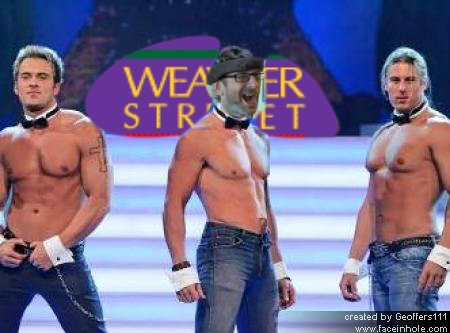
Hot Bar-Tender @ SV ...


In the Southern Village store of Weaver Street Market Co-operative, we have been told by management to smile more.

I kid you not. Apparently, we have been scoring low on our all-important Mystery Shopper Reports (yes, I know; we actually have THOSE in our co-op!). So. We have to smile more, to make management smile more.

Well. If it’s customer-friendly they want …

… good-bye Hot Bar. Hello ‘Hottie Bar,’ and the newly-restyled Hottie Bar-Tender!!

The lights will be dimmed. Stools out front. A sports TV to one side. And the ubiquitous Disco Ball gently rotating in the background, to the insistent, sexy tones of 24 x 7 Barry White.

I have undergone an extreme make-over. Uniform will now be gelled hair, waistcoat and an ever-changing selection of brightly-colored, lycra muscle thongs.

The Weaver Street Market logo will be delicately applied each day, in dazzling pink lip glitter, to the freshly-exposed rear regions – and, if you’ve never seen two Weaver Street logo’s flesh-wrassle, prepare to be entertained (every day, but Sunday; noon, tea-time and a special full-frontal show, when I close the Hottie Bar at 9.00pm).

I am no longer Chef Geoff. Please refer to me in future as ‘The G-Prince.’ I will be cooking and serving my food in a soft, suggestive Andalusian purr, that will make Antonio Banderas sound like … well … a pussy-cat:

“Can I tempt you with my … MEATloaf ... garneeeshed with my fully-RIPEned, ROOTING vegetables, uh huh … ??”

Oh yeah! We’ll put up that Mystery Score …

♫”Girl, I don't know, I don't know why; can't get enough of your love babe"♫

Wednesday, November 16, 2011

Backdoor Hiring Freeze ... ??

Further to my comments last week about Weaver Street Market Co-operative increasing sales, but hinting at wanting to put the squeeze on employees, two other anecdotal observations:

1) The most recent Market Messenger reported NO new employees. First time I can remember that since the formal hiring freeze was lifted in early 2010.

2) The word in my department is that the department manager thinks we are ‘heavy’ on hours. Even though our hours have been pretty much unchanged this past year. And certainly they have not increased by the same 10% our Southern Village store sales have.

Now, if you want to know what I think we can do about this, skip to the numbers at the end. Otherwise, stick with me, while I set out what I think is happening, and why it is important that it not be happening.

I have tried mightily to get the WSM corporate office management to discuss with us workers why it is that they have placed so much emphasis on sales growth these past two years. I put the point bluntly to them two years ago.

I wasn’t even allowed the opportunity at this year’s Unit Meeting, when we were told disingenuously that all financial goals were now ‘standard’ – for which read, not open to discussion.

The lack of discussion was a direct breach of our co-op’s policy. Board Policy specifically demands that employees be involved in the making of all major decisions that affect their workplace [Board Policy 2-3 (4)]. It also demands that workers not have imposed on them conditions or decisions that are unsafe, unduly undignified or unnecessarily intrusive – certainly not without discussion.

I do not think it is a stretch to call these continuing, unexplained demands for increased sales an intrusion. Especially when they do not seem to be accompanied by a commensurate increase in staff hours to be able to service the extra work.

A year ago, I began a dispute process (as allowed under Employee Policy 5.1 – you can find that in the Employee Policy Handbook, which is probably serving as the base to your kitty litter). I said that, since the decision that year to increase sales by 15% in 2011 had not involved shopfloor workers, it was in breach of Board Policy 2-3 (4).

I got a one hour meeting with our General Manager. He promised that increasing sales in 2011 would be matched with an increase in staff hours. Hasn’t happened. That is in breach of co-operative values of openness and honesty.

One of the primary features of the feedback from workers in the WSM Employee Survey this past year was that we workers felt we were overworked, understaffed and underpaid. We were promised our grievances would be addressed in action plans.

Frankly, the ‘real’ action plan seems now to be to find new ways to compel us to greater sales, while slipping and sliding our way to a ‘de facto’ hiring and staff hours freeze, without actually telling us why (breach of co-operative values of democracy, openness, transparency and honesty; breach of the corporate office’s own declaration in their Six Point Goal Plan to increase communication).

Of course, the reason the WSM corporate office management won’t actually come out and tell us what’s what is that it would leave them open then to my repeated charge that they continually make major decisions affecting our workplace without including us in the decision-making process.

What can we do?

A) Demand department meetings (of which we were promised more, under WSM's own Six Point Goal Plan), where we can ask our managers why the need for all these increased sales, and if staff hours will match increased sales, as promised.

B) Begin disputes under the Employee Dispute Process (Handbook 5.1). Make the dispute with ‘management’ generally. Say that management is in breach of Board Policy 2-3 (4) for not including workers in decisions about sales goals and staffing levels.

C) Become worker-owners. Stand for the Board of Directors. Vote for a worker-owner Board candidate who actually speaks up for workers at Board meetings. And make sure that, in future, the WSM Board of Directors and its corporate office are always in compliance with the Mission Statement, which requires that workers have a fulfilling work experience.

D) Maybe consider my Six Point Goal Plan.

I know it is difficult to stand up and speak out. But I look across America, and see Occupy every day. I look across the world, and see the Arab Spring. Folks are prepared to risk civil disobedience, in order to make points they know to be valid.

In our co-op, there should not even be the risk. There is no ‘civil disobedience in speaking up. Board Policy 2-3 (3) specifically protects employees against any action brought if employees have been expressing ethical dissent.

Remember this. Power is not given to the people. It is won by them.

Thursday, November 10, 2011

#OccupyWeaverStreet?? -- Social Justice AND Sales Growth ...

What does it mean when the employee 'Market Messenger' for Weaver Street Market Co-operative announces that we are making more of a profit so far this year than last; but urges workers to increase sales in any event; while a financial report of confusing figures, posted quietly on the break-room noticeboard, grimly declares that our payroll costs are ahead of our sales growth?

Hmm. Before I answer that, let me quote the Editor of The Co-operative Grocer, from his Editorial Notes in the October issue of CG:

"Investor-driven corporations are eroding the world’s human communities and the natural environment that makes those communities possible. Giving primacy to return on investment is key to why privately held corporations are doing so much damage. Cooperatives’ foundation in democratic ownership, with shared responsibilities and benefits, is why they offer a better direction and a more trustworthy structure. Cooperatives offer a well-defined alternate means of addressing social injustice and organizing enterprise that meets basic needs."

Ooh. Sounds good. Like spreading a thick layer of Occupy all over your morning muffin, isn't it? Dave continues - and this is where it gets relevant to WSM:

"However, cooperative and capitalist firms alike, along with public and governing institutions, are challenged to shift their outlook to a recognition of limits: limits to debt, to resource consumption, and even to THE GOD OF ECONOMIC GROWTH. If conservation and governance are not grounded in a more stable and democratic economy, many shared improvements will be lost. Private capital’s social war will spread until its productive forces are themselves destroyed by the collapse of debt-based growth and by climate chaos."

If Occupy is about anything, it is about getting off the consumerist/capitalist/economic-growth-is-all bandwagon. And yet here is our very own local co-op whipping us into a frenzy to sell, sell, sell, at whatever cost, using all the marketing gimmickry in the consumerist handbook. Why?

Why did we need to achieve a 9% sales growth in 2010, and what happened to it? Why do we need to achieve yet more sales growth this year, and what is happening to it?

And what payroll growth? I'm not aware of massive new hiring. Certainly not of my department taking on 10% more staff, or of my receiving a 10% pay increase (my Southern Village store is currently recording a 10% sales increase for 2011).

And what is the starting point for saying that payroll is growing too quickly? The common view around the co-op (at least among shopfloor workers) is that The Great Recession left payroll too light in any event.

Co-op's exist solely for the purpose of providing for the common needs of their stakeholders - and that includes employees, consumers and owners, not just the management in the WSM corporate office.

I do not hear consumers demanding to buy 10% more. And I do not hear workers demanding to work 10% harder. Indeed, the talk in my department (kitchen) in SV is that we are overworked already.

So, what does this all mean? It means that workers are going to be asked to work even harder for the remainder of this year, without seeing a commensurate growth in payroll. That means working harder for less, as we go along. All over again.

And. What is worse. Workers are not being given any opportunity to discuss these figures, or debate what effect they should have on our working environment, notwithstanding the fact that one of the primary clauses of WSM's Mission Statement is that workers should experience a fulfilling work environment.

I write elsewhere that, in future, companies should be responsive not only to investors, but also to employees and the community. In our co-op, as Dave says, that should already be a reality.

It is not in Weaver Street Market Co-operative. It should be. Some consumers told me that they had been joking recently about #OccupyWeaverStreet. Why joke ... ??